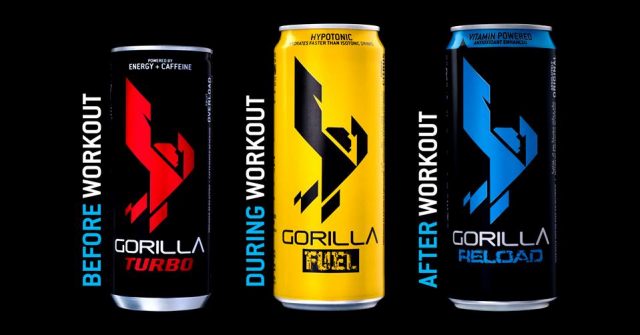
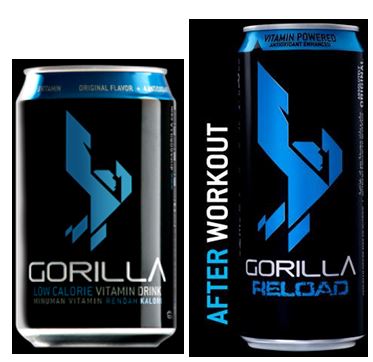
Malaysia-based Gorilla Athletica Sdn Bhd, the company behind the Gorilla Vitamin Drink, has added Turbo and Fuel to its line of workout drink. The existing Gorilla Vitamin Drink has also been renamed Reload and now comes in a slim can.
Image above shows the od packaging (left) and new packaging (right).
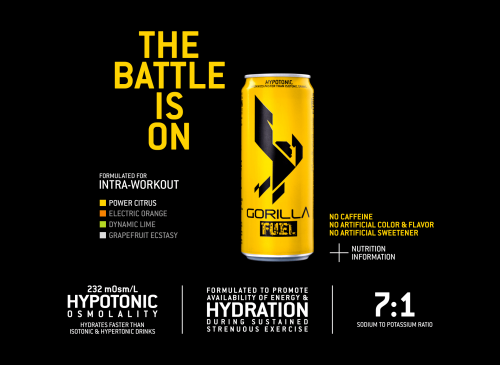
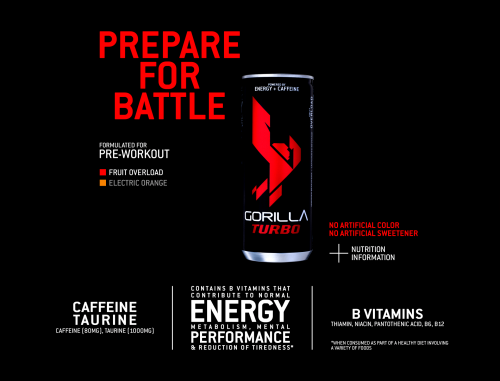
The product benefit and function for the Gorilla range is now very clear. Gorilla Turbo is consumed before workout, Gorilla Fuel is taken during workout and Gorilla Reload is meant for after workout.
Here are the product descriptions of Gorilla Turbo & Fuel
Focusing on convenience stores and gyms
Gorilla Reload is available at 7-Eleven. The new Gorilla Turbo and Fuel were spotted at KK Mart, a 24-hour minimarket chain, but not yet available at 7-Eleven.
The company has made available all three beverages at selected gym and fitness centres, which is a key distribution channel. This channel ties in well with the fitness focus of the Gorilla beverages.
Gorilla Athletica is actively sponsoring endurance races, marathon, running events and other outdoor recreation activities to engage its target consumers.
Overseas markets
The company has expanded beyond Malaysia with Australia and Maldives being its first two major overseas markets. In Australia, Gorilla is distributed by Transworld Trade Pty Ltd, a company incorporated in September 2015 and in Maldives by Dial Trade & Travels Pvt. Ltd. In Maldives, Gorilla was the official hydration partner for TWI7SAL 2016, a one-day friendly Futsal cup held by Maldivian Twitter users in August 2016.
Rather than casting a wide net, Gorilla is focusing on the niche market – fitness enthusiasts. This approach will help build up loyal followers and this in turn ensures repeat purchase.
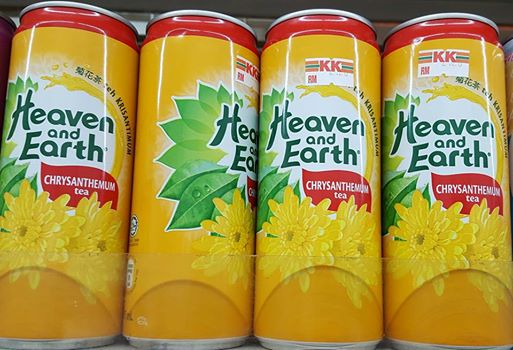
The Coca-Cola Company has enriched the line-up of its Heaven & Earth range with an all time Malaysian favourite – chrysanthemum tea.
Heaven & Earth was born in Singapore in 2000. It only crossed the Straits of Johor into the northern neighbour Malaysia in 2012 with the introduction of Ice Lemon Tea. Since then, the Heaven & Earth range has expanded to include Jasmine Green Tea, Ice Passionfruit Tea and Ayataka (launched in July 2016) in 315ml, 500ml and 1,500ml packaging format.
In Malaysia, chrysanthemum tea is a crowded category dominated by the likes of Yeo’s (Yeo Hiap Seng), Drinho (Lam Soon), Delite (Amoy Canning), F&N, Marigold (Malaysia Milk) and Homesoy (Lam Soon). The new Heaven & Earth Chrysanthemum Tea serves to provide consumers with another choice and broaden the brand into the huge Asian packet drink space.
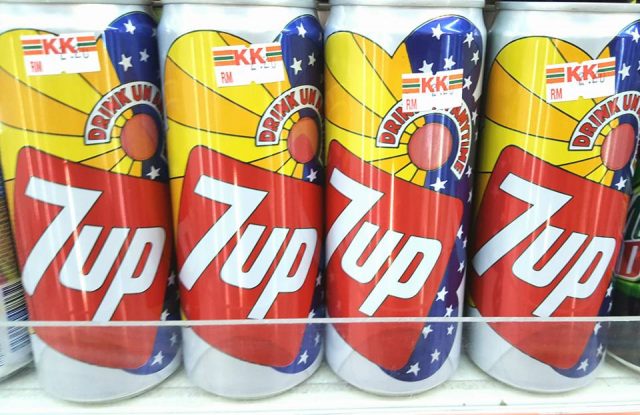
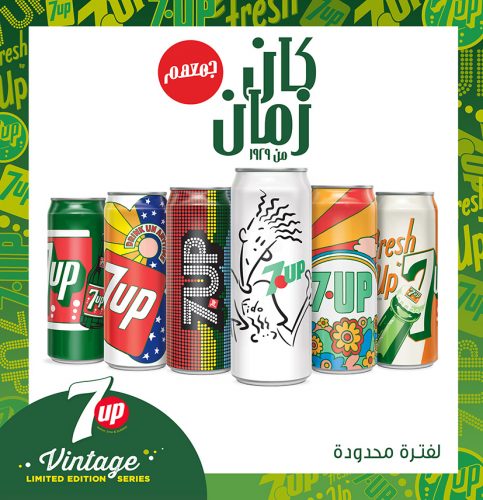
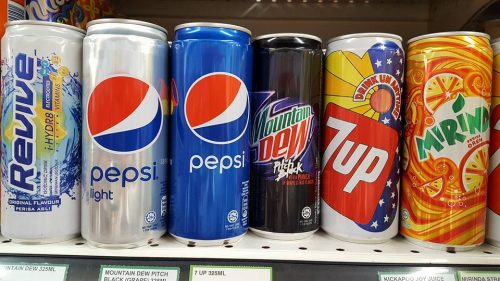
The 7Up limited-edition vintage cans have arrived in Malaysia after making rounds in other countries. Carbonated soft drink companies have a few common tricks up their sleeves to drive sales and these include packaging size (i.e. slim can), limited edition, formulation (i.e. stevia) and new packaging design.
This time, 7Up has chosen limited edition with the release of the new vintage cans. There are a lot more designs in the vintage range but only one design was spotted at KK Mart and that was the 1960s Dude design. Back then, 7Up was calling itself the “uncola” with the slogan “Drink Un Anytime.”
Finally, Pepsi goes for slim can
The 7Up vintage can signals the start of PepsiCo in Malaysia embracing the slim can. Aside from 7Up, all the beverages of Etika, the bottler of PepsiCo, are now available in slim can. The latest development means the two cola companies in Malaysia have all finally switched to slim can, a trending packaging format offering space/cost savings and improving brand image to attract younger consumers.
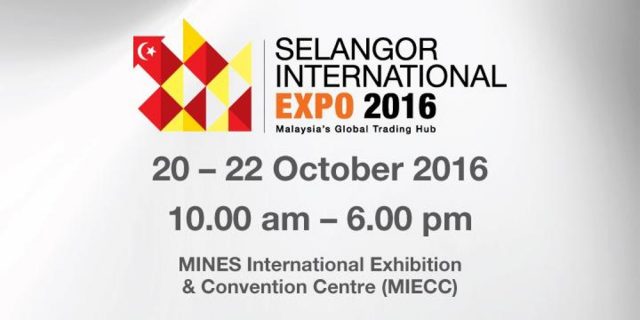
The author attended the Selangor International Expo 2016 for the first time on Saturday (22 October 2016). The expo was really good because it had lined up a lot of conferences and short talks by leading entrepreneurs sharing their business acumen with the general public.
D’Herbs – passion drives success
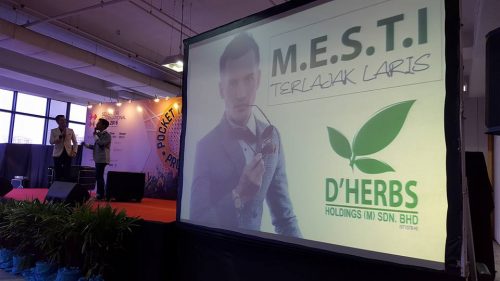
Malaysians are no stranger to Dato’ Aliff Syukri bin Kamarzaman, the founder of D’Herbs, a beauty product and health supplement company. According to Aliff, the company’s annual turnover is RM 120 million (USD 28.6 million), a stellar performance given the fact that this company has only existed for six years. D’Herbs now has an international reach spanning Singapore, Cambodia and Brunei.
D’Herbs products are targeted mainly at Malays. It has recently expanded into fashion. The key to success for this handsome lad born in 1987 is passion and marketing acumen. He stars in most of his advertisement and has a strong following on social media, which in turn drives sales. D’Herbs products are sold through stockists, jamu outlets and directly to consumers. The rise of the likes of D’Herbs and Vida Beauty are set to tip the balance in an increasingly tight race with multinationals and local firms for a share of consumer’s spend on beauty products.
https://www.youtube.com/watch?v=oOmZI_9EXhQ
Now back to the food and beverages at Selangor International Expo 2016.
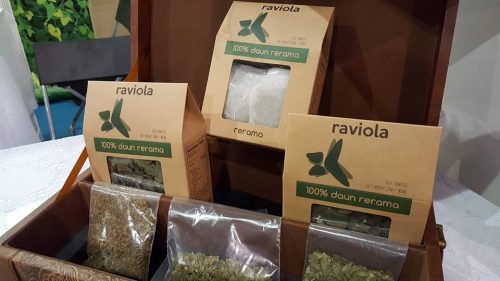
Daun rerama (Butterfly leaf)
The tea from butterfly leaf (Mariposa Christia Verpertilloris) is gaining popularity as a herb to cure cancer, gout, migraine, dengue and other diseases and ailments. Some Malaysians are planting it at home but the best butterfly leaf comes from Thailand.
In terms of medical research, local Universiti Putra Malaysia (UPM) has discovered anti-cancerous and anti-inflammatory characteristics in the red butterfly wing plant. The university said in early 2016 that it would conduct stage two trial involving tests on animals. The test is expected to be completed by the end of 2016 and would pave the way for more recognition of the efficacy of butterfly leaf as a treatment.
Alla Fonte Energy Drink and Juices
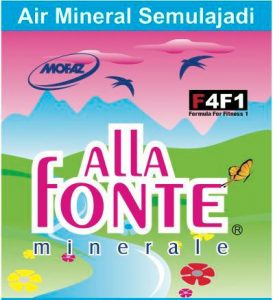
Alla Fonte, a brand by Mofaz Direct SA Sdn Bhd, is synonymous with its Alla Fonte mineral water. The products of Alla Fonte are in pink as part of the brand identity.
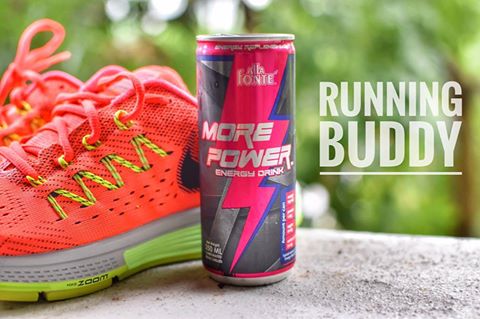
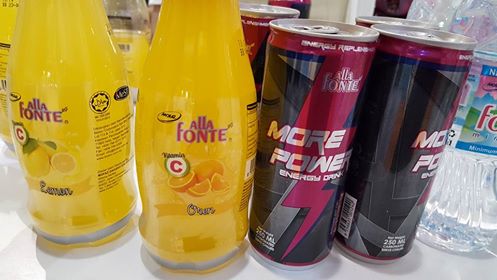
The company showcased two new products – Alla Fonte More Power Energy Drink and Alla Fonte Orange and Lemon Flavoured Drink at the Selangor International Expo 2016. Both products are now available at Circle K convenience stores run by an affiliate of the company as well as in Mydin.
The Alla Fonte Orange and Lemon (370ml) contains vitamin C. The key ingredients are water, sugar, citric acid, sodium chloride, vitamin C, permitting flavouring, food conditioner and preservatives. For each 100ml serving, the vitamin C content is 50.4mg, total sugar is 7.9g and energy is 37kcal.
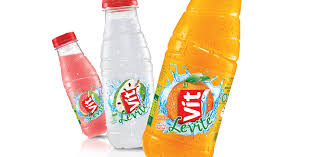
Alla Fonte Orange/Lemon tastes like flavoured water akin to the Danone’s Vit Levite light fruit-flavoured water, launched in Indonesia in 2014.
Grow your own oyster mushroom at home
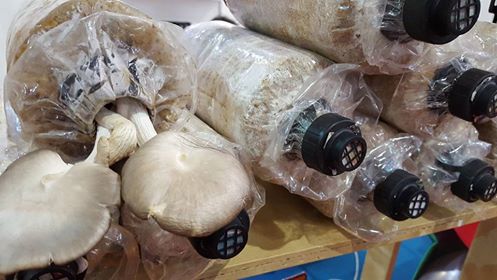
RJB Empire Group Holding Sdn Bhd, a home grown company known for “Pioneering the economy of global Muslim community, exhibited among others oyster mushroom that can be grown at home. Each canister sells for RM 5. This product ties in with the clean-eating diet trend where practitioners consciously choose food that is not or minimally processed. The only way to ensure food is not processed is to grow your own food. Growing your own vegetables at home has the potential to become a trend once the cost of hydroponic technology goes down.
Jamu Kocok
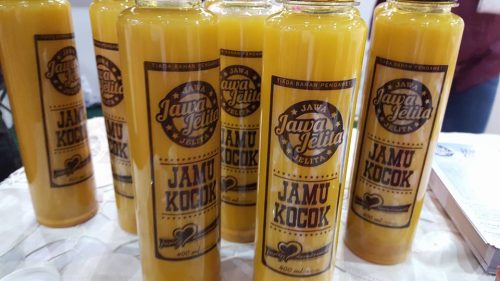
The ready-to-drink (RTD) turmeric-based Jamu Kocok by Jawa Jelita Solutions addresses women’s health problems. Jamu or herbal drink is traditionally consumed by Malays to treat various illnesses. In Indonesia, jamu is popularly peddled from door-to-door. Now, jamu is moving with the time. Companies are working to popularise jamu through modern coffee shop and RTDs. Jamu Kocok is seen as following the same path to provide convenience and traditional jamu benefits to modern consumers.
Microcluster water
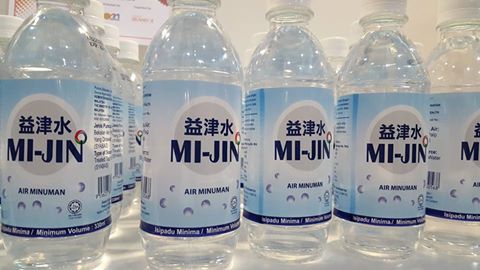
Mi-Jin Water (益津水) micro-clustered water (小分子水) alkaline water that contains fewer molecules. The water allows the body to be hydrated quicker. Mi-Jin Water carries a premium pricing, thanks to the use of advanced water treatment technology. It is manufactured by Universal NutriBeverage Sdn Bhd and distributed by Insi Mika (M) Sdn Bhd.
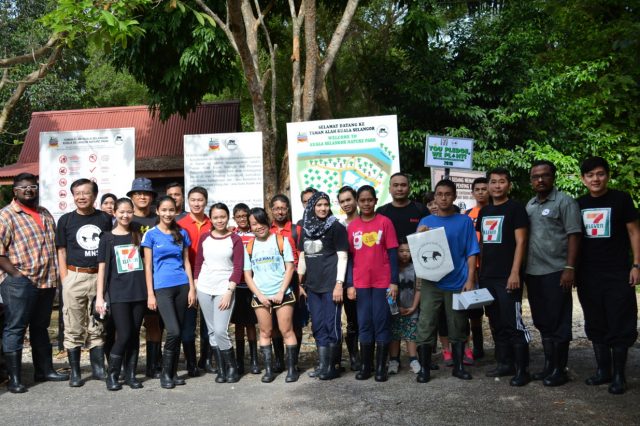
Photo: (2nd from left) Malaysian Nature Society President, Mr. Henry Goh, (3rd from right) Marketing General Manager of 7-Eleven Malaysia, Mr. Ronan Lee and volunteers from 7-Eleven Malaysia and Malaysian Nature Society.
Kuala Selangor, 8 October 2016 – 7-Eleven Malaysia, the country’s largest standalone convenience store operator today announced the total number of pledges received from its recent CSR environmental campaign, You Pledge We Plant; Battle Against Climate Change alongside its partner, Malaysian Nature Society during the campaign’s fulfillment exercise at Kuala Selangor Nature Park.
This CSR campaign is one of many carried out by 7-Eleven Malaysia under its Community Care program following its 3 guiding lights of responsibility, namely, Society, Workplace and the Environment and is also in tandem with other 7-Eleven’s across the world dedicated to its CSR goals of reducing its environmental footprint and educating about climate change in conjunction with 7-11 Day.
The campaign, which ran from 11th July until 12th August 2016 exclusively online focused on educating the public via a series of daily posts on the impact of climate change as well as seeking a pledge from sign-ups to commit to at least one carbon footprint reducing act and for every pledge received, a tree will be planted.
A total of 2070 pledges were received from concerned netizens and among the personal commitment choices were such as conserving water, carpooling, reducing food wastage and the highest choice among all, switching off anything that uses electricity when not in use, which garnered more than 75% among all pledgers.
“Across the country, more and more members of the public are becoming passionate about environmental conservation, are willing to make a difference and we seek to play a role in facilitating that,” said Mr. Ronan Lee, 7-Eleven Malaysia’s General Manager of Marketing during the tree planting pledge fulfillment event. He added “Every initiative and effort counts as we seek to give ourselves and our future generations a better world to live in and we’re delighted with the response received as there are now a further 2070 people who understand better about climate change, are willing to make changes to reduce their personal carbon footprint as well as spread their knowledge further and we applaud each and every one of our pledgers”.
The President of the Malaysian Nature Society, Mr. Henry Goh commented, ” The insights received from this campaign will come in handy in our research and future conservation outreach programs and we wish to thank 7-Eleven Malaysia for their support in their endeavors with us.” He added, “We’ll be planting around 200 mangrove saplings here today, with the mangrove ecosystem being the frontline against climate change and the balance 1800 plus saplings will be allocated to other sites nationwide and planted by our field offices.” He concluded by saying, “We all have a role to play in protecting Mother Nature and we will continue to play our part in educating the masses on the importance of environmental conservation.”
7-Eleven Malaysia is the pioneer and the largest standalone 24-hours convenience store operator in the country with over 2,000 outlets nationwide. For more information, please log on to www.7eleven.com.my or follow 7ElevenMalaysia on Facebook.
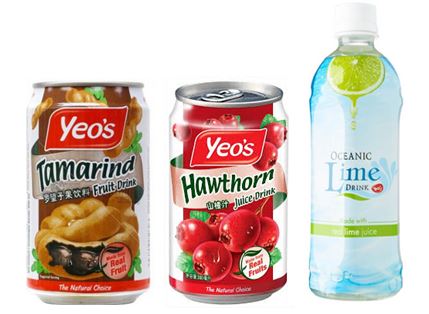
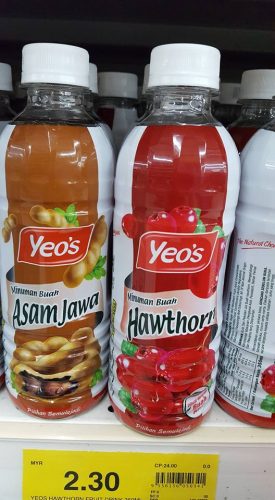
Yeo Hiap Seng (Malaysia) Berhad has recently launched three new beverages in Malaysia. The first two are the ones saw at MIHAS 2016 – Hawthorn and Tamarind (Awam Jawa). Unlike the can version at MIHAS 2016, the two drinks are packed in PET format. The selling price is RM 2.30 (USD 0.55) per bottle (350ml).
The hawthorn drink is unique as there is nothing of its kind in the market. The taste is pleasant with a hint of Ribena.
Oceanic Lime Drink
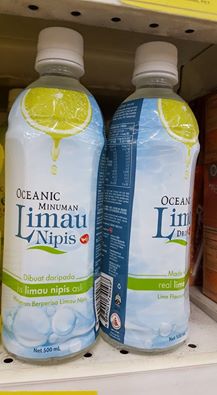
Also introduced into Malaysia around October 2016 is the Oceanic Lime Drink (Minuman Limau Nipis), which first appeared in Singapore around April 2016. At the moment, the three new Yeo’s beverages are available at hypermarkets (Giant and Aeon Big) and not in 7-Eleven. The retail price of Oceanic Lime Drink (500ml) is RM 3.00 at Aeon Big or RM 2.80 at Giant.
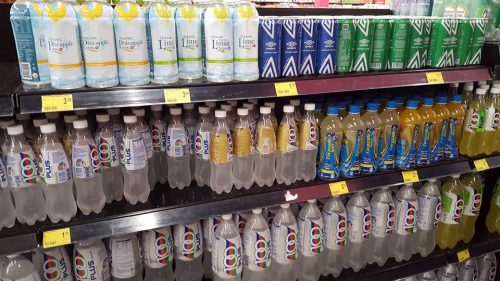
At Aeon Big (image below), the Oceanic Lime Drink is placed in the isotonic drink rack.
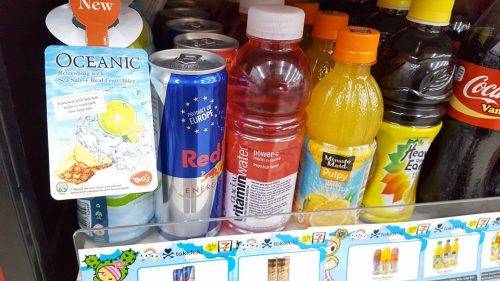
In December 2016, the Oceanic Lime Drink entered the convenience store channel – 7-Eleven (image below) and myNEWS.com.
Unilab, the manufacturer of prescription and consumer health products in the Philippines, is addressing nutrition deficit in pregnant mothers and meeting their craving needs with the new Crave Healthy.
First fortified snack product for pregnant women
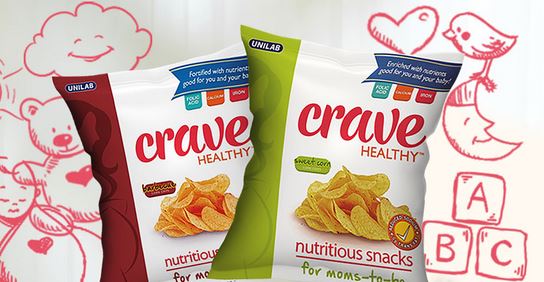
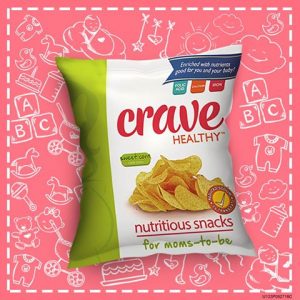
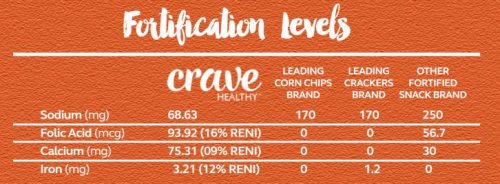
Crave Healthy is a corn chip. The company claims it is the ‘first snack product in the Philippines that’s specially developed by doctors and nutritionists for pregnant women.’ It contains iron, calcium and folic acid and is low in sodium.
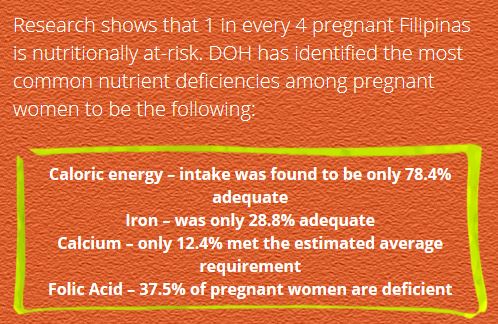
According to Unilab, the real reason for coming up with such a product is 1 out of 4 pregnant Filipinos are not getting the right nutrients.
Unilab is taking a big leap into the healthy snacking segment with Crave Healthy for pregnant mothers. Food for mothers-to-be usually comes in the form of home prepared food that is burst with nutrition.
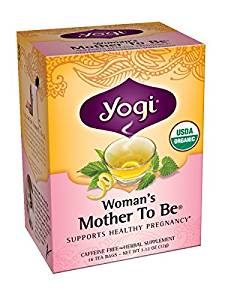
Few packaged goods company will have the desire to introduce packaged food specially for pregnant mothers because this would put themselves in a difficult situation ethically. Even if they do so, it usually comes in products that are seen less decadent like Yogi tea.
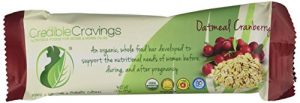
Even if the food is to satisfy the cravings of mothers-to-be, it will be in the form of a healthy snack bar like CredibleCravings probiotic perinatal food bar fueled by probiotic GanedenBC30. The range includes Chocolate, Lemon Ginger Greens and Oatmeal Cranberry. The bars are made from natural ingredients including organic fruits and veggies and sprouted seeds.
Almost none is in the from of chips, which are seen as bad for health and could affect the health of unborn babies. Perhaps the fortified appeal of Unilab’s Crave Healthy is enough to assure pregnant mothers in the Philippines about its safety to warrant a small bite to satisfy their craving.
These days, if you try to get yourself a can of RTD coffee at 7-Eleven Malaysia, you will be greeted with the Wonda Coffee song. The song goes like this “Wonda coffee, enjoy a can of Wonda coffee today.” This is push marketing at point of sale (POS).
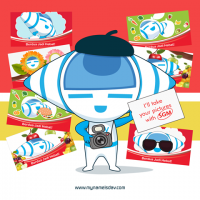
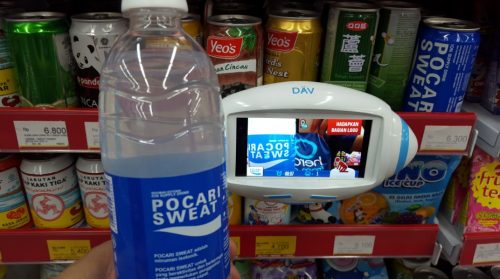
In Indonesia, the interactive marketing at POS comes in the form of DAV, also known as the world’s first measurable, one-on-one interactive media placement. DAV (Digital Avatar) devices are available at Alfamart, Alfamidi and Lawson. As of 19 Oct 2016, the number of interactions has reached 1,646,844. The DAV device first appeared on 14 August 2015.
DAV in action with SGM Eksplor milk powder in 2016.
https://www.youtube.com/watch?v=qq1_6jedFjg
These two forms of interactions at POS have made shopping at convenience stores more fun. However, more creative content is needed to sustain consumer interest in order to be sustainable in the long run as consumers have a short attention span.
Product recalled on Saturday but most people only aware on Sunday
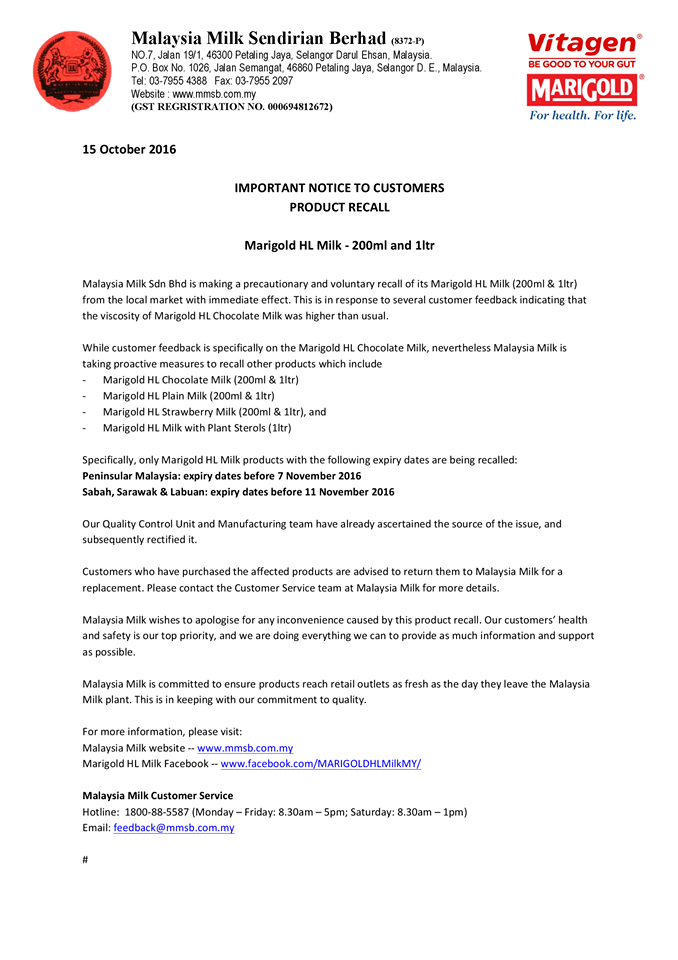
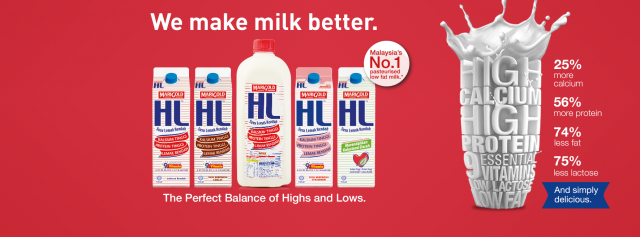
Malaysia Milk Sdn Bhd announced the recall of Marigold HL Milk (200ml and 1L) from the Malaysia market with immediate effect on 15 November 2016 (Saturday). However, most of the customers only became aware on Sunday. The hotline was closed on Sunday. It only operates Monday to Friday (8.30am to 5pm) and Saturday (8.30am to 1pm).
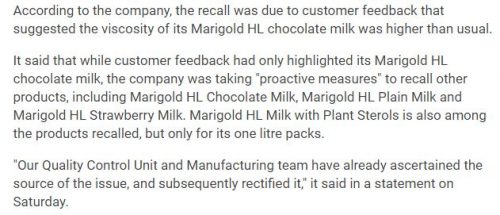
The company found issue with the chocolate milk but the recall also included other plain milk as a precautionary move.
Higher-than-usual viscosity but nobody understands
The product recall was in response to “several customer feedback indicating the viscosity of Marigold HL Milk was higher than usual.” The explanation unfortunately is not relevant and does not resonate with ordinary Malaysians. They do not know what is “viscosity.” Google search does not help either.
Essentially, nobody except those inside the dairy industry, knows exactly what has happened to Marigold HL Milk. Based on the messages left by consumers on Marigold HL Milk Facebook page, they were unclear about the effect of this issue on their health. Bryan Ng asked if it would be fatal, while Ng inquired about the side effects.
Delayed response
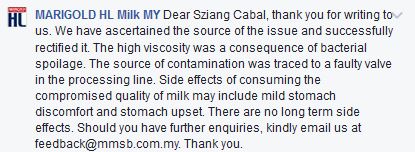
Both Ng and Bryan posted the queries near midnight on 16 October (Sunday). Malaysia Milk only made public its reply at around 6pm the following day on Monday (17 October).
Most of the official replies to the customer Facebook queries that can be publicly seen were made on Monday at around 6-7pm.
Bacterial spoilage as the real reason – 17 October
The real reason, according to Malaysia Milk, is bacterial spoilage, which causes high viscosity. Unfortunately, this was not explained in the official statement dated 15 October 2016 even though it says the team has ‘ascertained’ the issue. The company should have done more to improve transparency by issuing another press statement on 17 October 2016 to explain about the bacterial spoilage.
Mass media repeating the official line
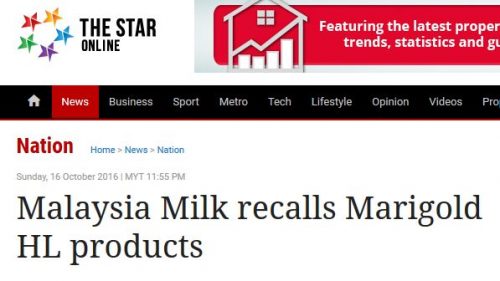
The first reaction by the mass media including The Star, Sinar Harian, Sin Chew Jit Poh and New Straits Times on 16 October 2016 was to repeat the official statement about high viscosity and the recall.
Mentioning only high viscosity – 16 October Sunday 11.55pm
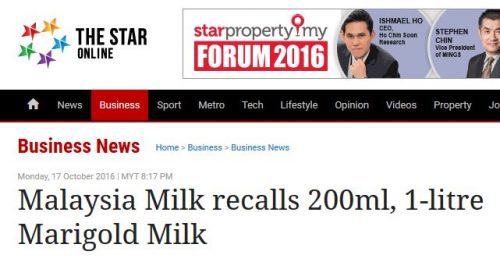
Confirmed about the bacterial contamination – 17 October Monday 8.17pm
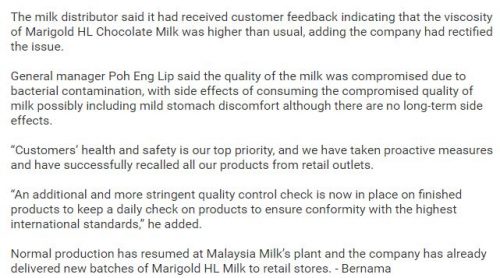
The official reason, bacterial contamination, was only reported the next day by Bernama, The Malay Mail Online, The Star (Bernama article), Singapore’s Straits Times, Singapore’s Channel 8 News and The Borneo Post (Bernama article) citing Malaysia Milk General Manager Poh Eng Lip that “the quality of the milk was compromised due to bacterial contamination, with side effects of consuming the compromised quality of milk possibly including mild stomach discomfort although there are no long-term side effects.”
Consumers confused about the expiry date
Most of the messages on the Marigold HL Milk Facebook page were about which products with their expiry date that were entitled for replacement. According to the official statement, only Marigold HL Milk with the following expiry dates are being recalled:
1.) Peninsular Malaysia: Expiry dates before 7 November 2016
2.) Sabah and Sarawak: Expiry dates before 11 November 2016
On-the-ground look on the 2nd day of the recall
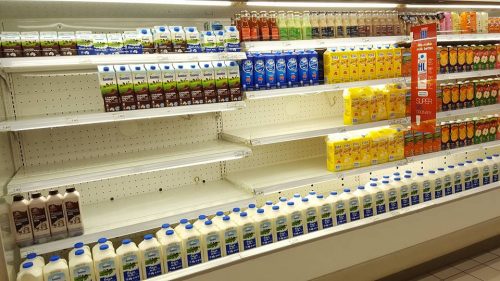
All the Marigold HL Milk was taken off the shelves at Cold Storage, Jaya One (image below was taken on 17 October 2016). This shows retailers have taken prompt actions to remove the affected products off their shelves.
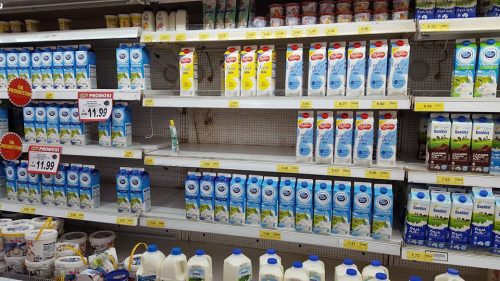
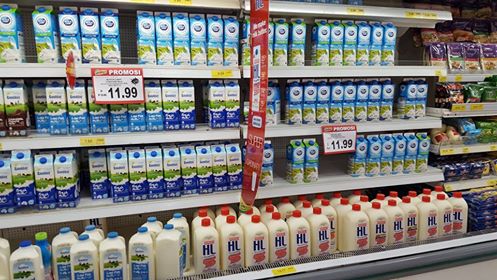
At Giant Taman Connaught, the Marigold HL 2 litre milk was still available as it was not part of the recall (image below).
Key takeaway
The company has been forthcoming in issuing the recall of not only the affected chocolate flavoured milk but also other plain milk including those with plant sterols.
However, the official statement on 15 October 2016 did not instill confidence because it did not explain the impact of drinking milk with higher-than-usual viscosity. The official statement by Malaysia Milk on 15 October 2016 can be interpreted as an attempt by the company to use technical term for damage control. This comes even though it has ascertained the source of the issue. The company eventually explained in detail about the negative impact of drinking milk with high viscosity on 17 October 2016 through the media without accompanied by another official press release, a move seen to mitigate the negative impact on the brand. (See the updates below).
Now the hard part is to regain consumer confidence and handling disgruntled consumers with compensation.
Updates on 19 October 2016:
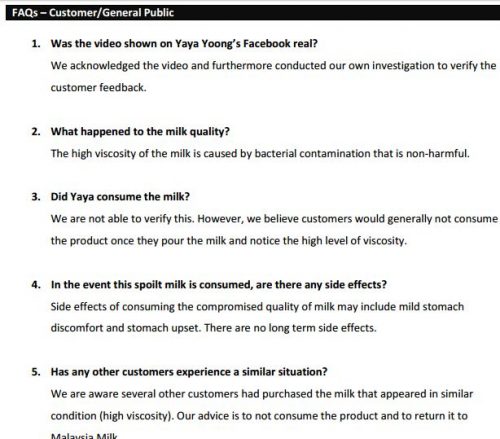
It appears there is a second official statement but it is not available on Malaysia Milk Sdn Bhd website/Marigold HL Milk MY Facebook page. There is also a small FAQ at the end off the 1st official statement. The FAQ explains what happens when you drink milk with high viscosity.
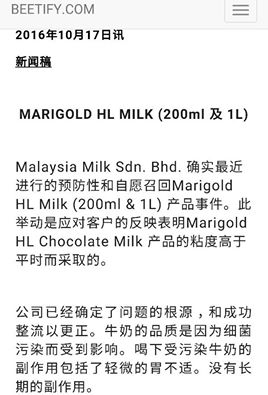
Here is the second official statement in Mandarin. It mentions about the contamination issue and is the press release used by the media for their reports on 17 Oct 2016. The question is why did the company not make this available to the public?



 Essentially, nobody except those inside the dairy industry, knows exactly what has happened to Marigold HL Milk. Based on the messages left by consumers on Marigold HL Milk Facebook page, they were unclear about the effect of this issue on their health. Bryan Ng asked if it would be fatal, while Ng inquired about the side effects.
 Delayed response