Home Blog Page 1181

Penang White Curry now with ramen version, MyKuali improves formula, Maggi Royale “You buy, we cook”
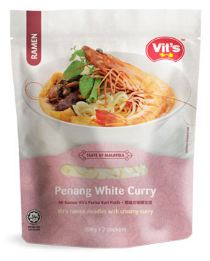
Ramen Penang White Curry? Yes, Vit Makanan (Kuala Lumpur) Sdn Bhd, the company behind the Vit’s 唯一 noodle brand has finally entered the Penang White Curry noodle bandwagon with something unique by focusing on what it does best – noodle. The Penang White Curry with the ramen noodle in pouch will not only stand out in a crowded aisle, it will also reinforces the better for you credential. At the time of writing, Vit’s Penang White Curry Ramen is still not available in the market.

The ramen noodle has 2% fat compared to fried instant noodle, which Vit’s claims to have 20% fat. Unlike other ramen noodle, which requires refrigeration, the Vit’s ramen noodle is precooked and vacuum sealed, making it suitable for storage at normal shelf temperature.

The down size of the latest product is each pack of  Vit’s Penang White Curry Ramen (196g) contains two individual packs of ramen only enough for two people. This makes the ramen noodle more expensive than the other non-ramen white curry noodles in the market, which usually comes in a pack of four. I bought this Vit’s ramen noodle at the halal food exhibition MIHAS 2015 for RM 6. As a comparison, Maggi Royale Penang Seafood Curry 4 x 91g retails at Tesco at a price of RM 8.29. [Vit’s Penang White Curry is selling at Aeon Supermarket at a promotion price of RM 6.50 on 27 April 2015]

The author’s own adaptation

As for the taste, I will let Ramen Rater do the rating.

According to Vit’s website, the ramen series include Penang Asam Laksa and Penang Hokkien Mee. There is also a line of premium instant noodles with the same flavours albeit in normal fried noodle, not ramen.

Premium instant noodle
Freshly cooked ramen

MyKuali New Formulation

The debut of Vit’s Penang White Curry Ramen comes at a time when MyKuali has moved on the phase two. Consumers have spoken! The new MyKuali franchise now comes with a new formulation with an “improved noodle texture and soup base with garlic garnishing.” The improved noodle is available at Giant, Jason’s, Mercato and Cold Storage.

New formulation

Maggi Royale wants to cook for you

At Mid Valley in March 2015

Maggi Royale continues with its marketing blitz and this time with an in-store activity in March 2014 to emphasis the ‘authentic Penang hawker style’ taste of Maggi Royale Penang Seafood Curry. The activity was held at the entrance of Aeon Supermarket in Mid Valley. The place featured kopitiam style chairs and marble tables to replicate the street food atmosphere.

Kopitiam style chairs and marble table

Consumers who bought a pack of Maggi Royale and Maggi was served with freshly cooked noodles with fresh ingredients. This campaign served to demonstrate to consumers the instant noodle can taste really authentic if you know how to prepare it.

Cooking on the spot

Conclusion
 
The debut of Vit’s with the ramen noodle opens a new front in the Penang White Curry campaign. The focus of Vit’s approach is better for you through the healthier choice of ramen noodle. MyKuali continues to focus on getting the taste right, which is what it is famous for in the first place. The MyKuali White Curry Noodle is now V2.0 with new formulation based on feedback from its fans. Maggi Royale has gone on the route of the Asian premium noodle series with the Penang and Korean range and its in-store activities are still all about “the taste adventure.”
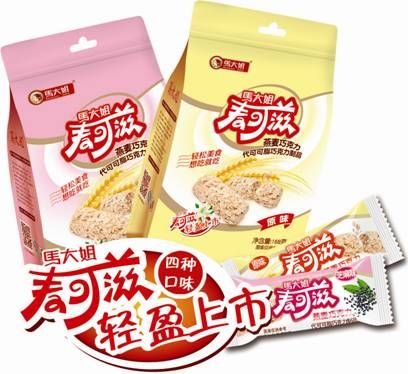
Oat choco gaining traction in China?

Oat choco, popular in Malaysia, seems to be gaining traction in China, the birthplace of oat choco, according to Rabobank analyst Sam Gao. In China, oat choco is known as 麦片巧克力 (oatmeal chocolate).

“The top-selling candy flavours online are not commonly found at foreign in-store competitors. Oatmeal chocolate is the top performer online in China, for example. Chinese manufacturers are adding oatmeal—for health appeal—or black plum—which tastes slightly sour—to sugar and chocolate confectionery products” – Sam Gao, Analyst – Consumer Foods at Rabobank

Ma Da Jie (马大姐) Mai Ke Zi (麦可滋) oatmeal choco

Data from China’s leading B2C platform Tmall shows sales of oatmeal choco in China in 2012 reached RMB 250 million. Among the leading players are Mai De Hao (麦德好), Jao Qin Jia (好亲家) and Ma Da Jie (马大姐). The unique selling point of oatmeal choco is it is seen as nutrition because it is primarily made from oatmeal and it is moderately sweet, good for those who does not want to consume a sweet snack. It also has a chocolatey taste from the use of either cocoa butter substitute or cocoa butter. Oat choco is targeted at office snacking, leisure and on the go occasions.

Apart from eating on its own, consumers are encouraged to dip and dunk it into milk.

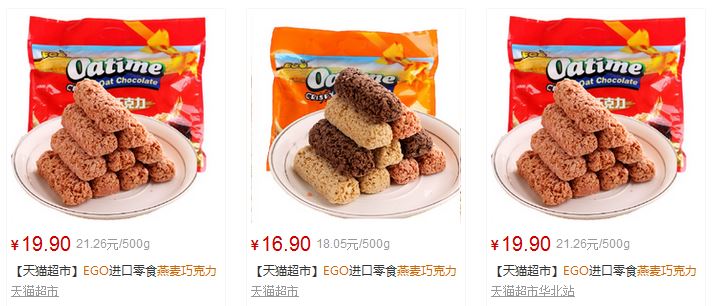
How long the popularity of oatmeal choco will last in China is hard to predict but it is currently well and alive as Singapore-based snack company Kee Wee Hup Kee Food Manufacture (EGO) is exporting similar products into China. The EGO oatmeal choco is made in Malaysia.

Made-in-Malaysia EGO brand oat choco from Singapore selling on China’s Tmall

In Malaysia, data from China’s Quanzhou city in Fujian province shows the city’s confectionery exports to Malaysia surged 66.33 times in 2014 to USD 11.31 million. The growth is largely attributed to the popularity of oat choco in Malaysia. Exports of oat choco from Quanzhou to Malaysia, the Middle East, Africa and other countries rose by more than 70 times in 2014 to USD 14 million. This shows most of the oat choco ended up in Malaysia. As Malaysian companies start to produce their own oat choco, there will be a time when Malaysians will begin exporting similar products to neighboring countries thus spreading the reach of oat choco and its popularity in the region.

How I became aware of Coke Zero

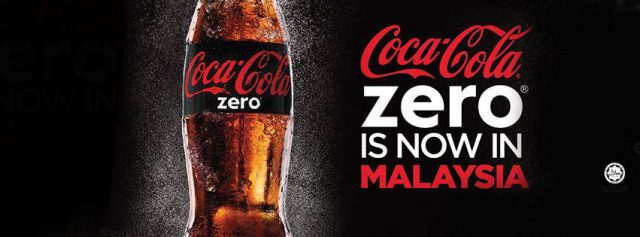
Coke Zero can now be seen everywhere. It was officially launched in Malaysia at the end of January 2015 but as a consumer, I was not aware about it until Coca-Cola ran a five-day campaign at 7-Eleven on 25-29 March 2015. The campaign saw a can of Coke Zero selling  for only RM 1! The irresistible price encourages consumers to try Coke Zero for themselves.

Afterwards, I started noticing Coke Zero advertisement on the free daily newspaper The Sun. The usual cinema I go to has started offering Coke Zero. Even though I rarely watch free-to-air TV, I still managed to catch a glimpse of the Coke Zero TV commercial on the TV. The TV commercial conveys the message that Coke Zero tastes very much like the normal Coca-Cola minus the sugar and calories.

The Sun 29 September 2015

The Coke Zero launch has surely served its purpose of creating awareness through multiple touchpoints – TV, newspaper and convenience store as well as social media. The campaign encourages people to try Coke Zero and effectively drives home the message Coca-Cola Zero does taste as great as Coca-Cola without the sugar and calories.

“Rasa sehebat Coca-Cola” or Tastes as great as Coca-Cola at Aeon Big

And by the way, according to the Rakyatpost.com, Coke Zero is supposed to be produced locally in Coca-Cola Malaysia’s factory in Bandar Enstek. However, if you look closely at the packaging, you will notice the Coke Zero currently selling in Malaysia is actually made in Singapore.

Gorilla storming into the Malaysian isotonic market

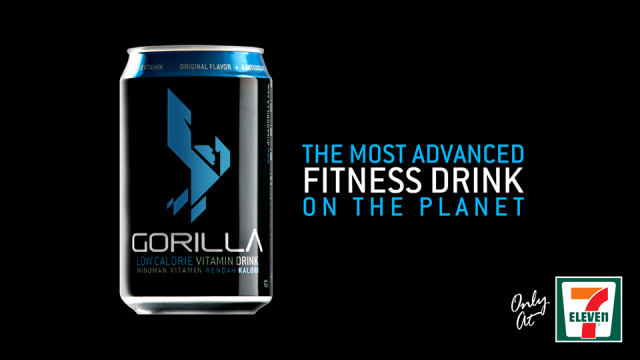
Gorilla vitamin drink, “Formula for health maniac,” has been launched in Malaysia and is made available through 7-Eleven, sports and gym centres. The drink claims to be the “most advanced nutrient powered beverage on earth” and only has 13g of sugar in each can. As a comparison, F&N 100Plus contains 21.5g of sugar.

7-11 as the key distribution channel and is sold at a price of RM 2.9 per can

The drink is not shy to reveal its nutritional content on the website as it believes it is much more superior than other isotonic and carbonated soft drinks. The “regular isotonic 1” in the chart below is no doubt referring to 100Plus, the market leader in the isotonic category in Malaysia.

Here is the detailed nutritional information with information taken from the brand website.

Gorilla uses stevia sweetener to achieve the low calories claim. Other ingredients in the drink include calcium lactate, zinc gluconate, acid citric, sugar, vitamins A, B1, B3, B6, B9, B12, C, D and E, magnesium lactate, preservatives, food conditioners and natural pitaya flavour.

Personally, I find there is a lingering stevia aftertaste and a hint of flavour commonly associated with energy drinks. Taste will be stumbling block for Gorilla to win over existing 100Plus fans. The use of the energy drink flavour is very much aimed at current energy drink consumers. This is reflected in the marketing of Gorilla, which is associated with sports such as boxing, futsal and climbing. Naturally, the consumer touchpoints for Gorilla are gyms and sports centres. Gorilla will be competing with other isotonic drinks and coconut water for a share of the fitness and post-workout hydration market. The energy-giving focus of Gorilla will help it win over consumers.

DASTO energy bar wins Gulfood Award, using local ingredients to help manage weight

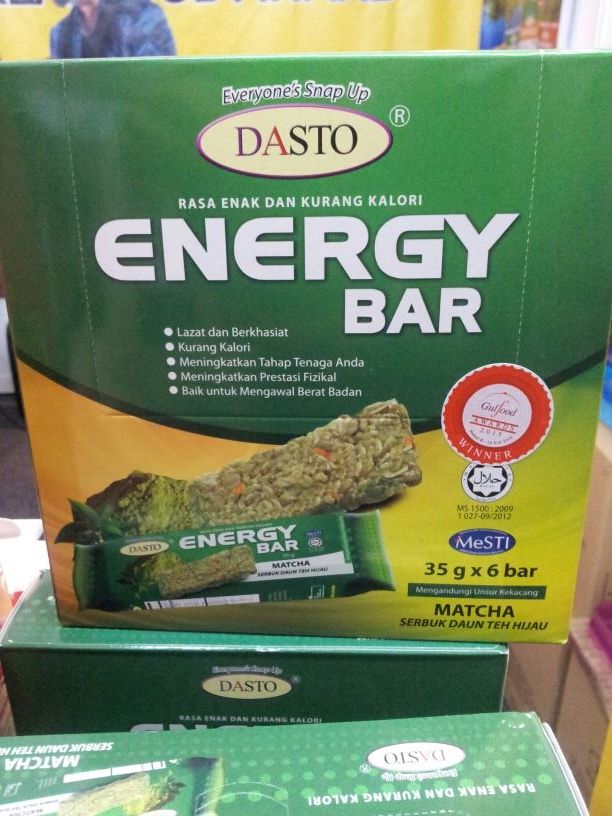
The DASTO Energy Bar Matcha has won the Best New Halal Food Award in Gulfood Award, Dubai in 2015 and was showcased at the recently concluded MIHAS halal fair in Kuala Lumpur, Malaysia. The 35g energy bar is made from matcha green tea powder, dry mango, almond, oat, nipah syrup, peanut butter, salt, canola oil and brown rice. It is high in zinc, calcium, fibre and low in calories and glycemic index. The energy bar helps to reduce calories, increase the energy levels and is useful for weight control. Apart from matcha, there is also a durian energy bar as well as the Crunch and Munch Mind and Muscle Energy Bar produced by the same company Dr Aishah Solution Sdn Bdn (DASTO).

Crunch and Munch Mind and Muscle Energy Bar

Dr Aishah Tul Radziah Lebai Hussin, commonly known as Dr Aishah, is quite an authority in weight control. She is also the founder of DASTO and runs a clinic with her husband in Sg Petani in the northern state of Kedah. Dr Aishah created a new Fast Amazing Result (FAR) weight management program to help individuals control and reduce their weight. The program was created after she herself experienced a rapid increase in weight to 68kg after suffering from menopause. Using the self-invented FAR method, her weight reduced to a normal level within 5 months.

WHO Noncommunicable diseases country profiles 2011
Managing obesity is now a pressing issue in Malaysia. According to the government, there are 2.5 million Malaysians who are obese and the number is rising due to unhealthy eating practice and the lack of exercise. The country has the highest percentage of people with overweight problem in Southeast Asia, according to WHO.

The alarming obesity and overweight problems has created demand for functional food and dietary supplement. DASTO is one of the companies that have made a name in this area. What is unique about DASTO’s formulation is it uses local ingredients such as dry mango, pumpkin and dry coconut as well as imported ingredients like oat, raisin and almond to make the DASTO Granola. Since the price of these products are higher than normal granola/energy bar, the companies plans to sell them through specialised channels such as pharmacy. At the moment, DASTO is available at AEON Big in Alor Setar and Butterworth, appointed agents and online.

A new factory in Perda Food Park, Butterworth will be completed within one year and this will boost the production capacity.  DASTO will also be launching the probiotic green tea made in collaboration with Institut Penyelidikan dan Kemajuan Pertanian Malaysia (MARDI) and the new protein bar.

Key takeaway:
– The use of local ingredients is the unique selling point of DASTO. Using local ingredients not only save cost but also make them relevant to the dietary needs of local consumers.
– Since the products are formulated by Dr Aishah, her medical background lends credibility to the product functional claims.
– Winning an award at Gulfood 2015 has improved brand visibility, locally and abroad. In fact, the company has signed memorandum of understanding to penetrate the Middle East markets.

Moolabar energy bar gets a more exciting look

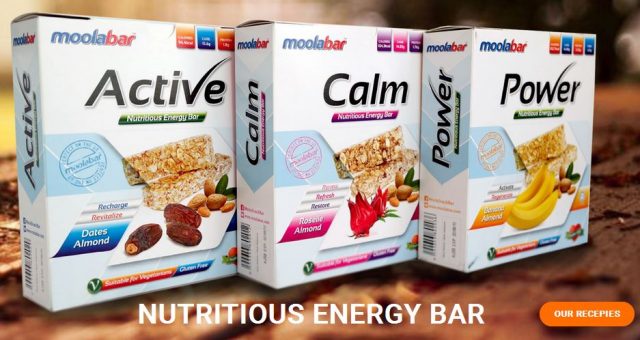
Malaysia’s Agro Jerneh Sdn Bhd, the company behind the Moolabar energy bar, has introduced a new, more sophisticated and relevant packaging that appeals to adults. The energy bar now comes with three variants Active (dates almond), Calm (roselle almond) and Power (banana almond) to target different functional usage occasions. The underlying key claims for all these products are:

– No preservatives
– Rich with fibre
– No artificial ingredients
– Low in calorie
– Nutritious & naturally tasty
– No cholesterol
– Natural novel flavour
– Gluten free

Moolah bar gives you natural energy

The key ingredients of the Calm variant are rolled oats, puffed rice, glucose syrup, roselle paste, almond flakes, honey, roselle candy, concentrated juice, maltodextrin, vegetable fat, skimmed milk powder and emulsifier: soy lechitin. Each bar weighs 22g and each pack contains six bars.

Photo taken at MIHAS 2015

It is prudent for Agro Jerneh to come up with a new packaging for Moola. As you can see, the old packaging, now targeting school kids, has a children-centric design. It does not stand out  in a crowded shelf. The company admitted the product was not doing well in stores and therefore decided to promote the old packaging in schools, while the new version will be sold in mass market retailers. At the time of writing, the new packaging is still not available in the market. The company also exports the energy bar to Oman and is aimed at children.

Agro Jerneh  produces Nutrixprezz energy bar for Felda Wellness Corporation. Nutrixprezz is sold primarily in the convenience store channel in Malaysia. An interesting fact about the name Moolabar. According to the company, they coined the name Moola because they wanted consumers to start or ‘mula‘ in Malay their day with the energy bar. The word ‘mula’ is given a more NZ sounding name ‘Moola’.

For the new packaging to work, marketing has to revolve around Calm, Power and Active. The gym channel is also a suitable place to promote the energy bar.

Maggi gives Malaysian consumers more value for their money

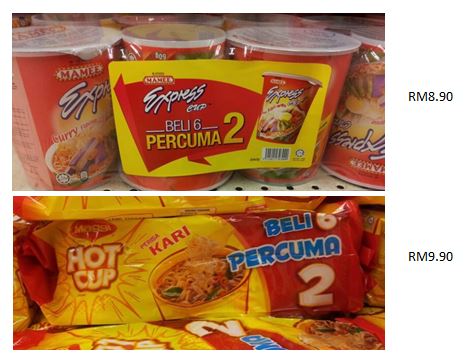
Malaysian consumers have turned cautious on spending following the implementation of the GST. Companies feel the pulse of the Malaysian consumers and are prepared to absorb some of the cost to encourage consumers to start spending again. Take the instant noodle category as an example. Both Mamee Double-Decker and Nestle have introduced the 6+2 (buy six, get two free) promotion for its cup noodles.

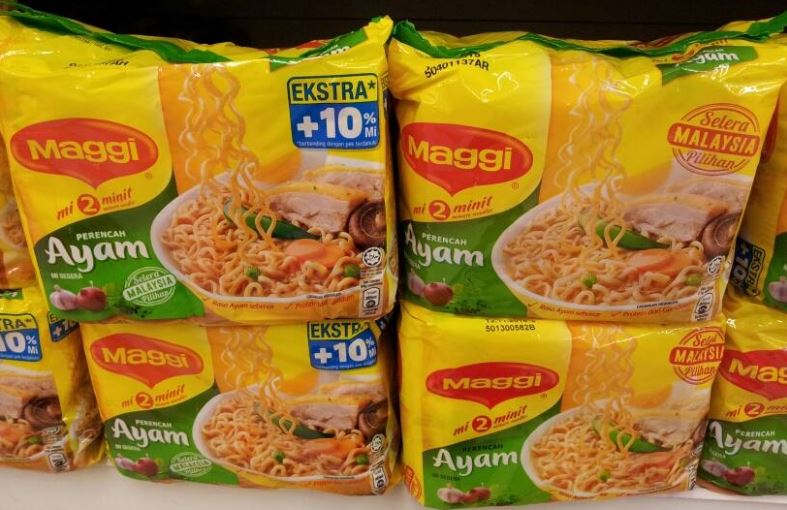
However, the most interesting development from Nestle is not the “6+2” but bigger pack size without changing the price. The new 5x90g pack comes with an extra 10% volume and is selling for RM3.99 (normal price RM4.79) compared with 5x83g previously. Even through the difference between 90g and 83g is not exactly 10% but 8.4%, it does show Nestle is taking the opportunity to highlight the brand’s ‘value’ preposition to wary consumers who are still reeling from the impact of the GST.

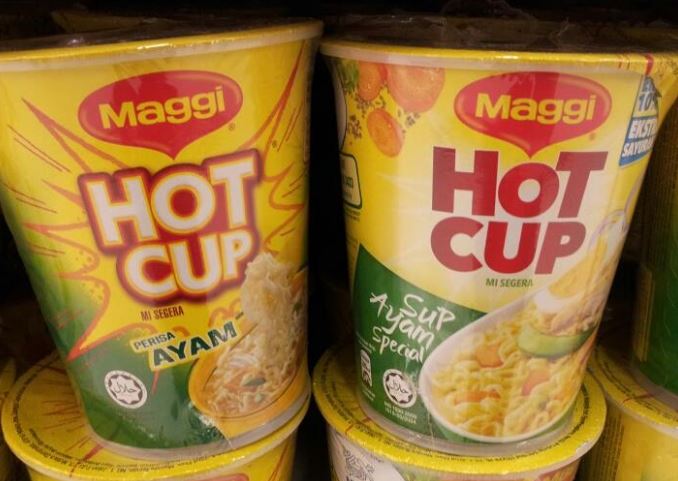
For the cup noodle, Nestle has not only added an extra 10% volume, it has also renewed the packaging design and has added extra vegetables such as sweet corn, cabbage and carrot. Nestle’s focus on ingredients echoes a similar strategy used by Super Group for its newly designed Signature instant noodles.

Maggi Hot Cup has a new look (right)

New Maggi Hot Cup with extra noodle and vegetables

The new Hot Cup also comes with a more palatable description. Instead of ‘perisa ayam‘ or chicken flavour, the new packaging describe the flavour as ‘sup ayam special‘ or special chicken soup, which is more inviting to the taste bud. With consumers struggling to come to terms with the newly implemented 6% GST, it will not be surprise to see other instant noodle players shifting their marketing to focus their attention to crafting a value-for-money image through better ingredients or larger pack size.

GST Watch: Infant milk powder becomes pricier after GST

Photo from Tesco Online Malaysia

I have compiled a list of milk powder prices – baby milk powder, growing up milk power and maternal milk powder from the Tesco online shop to detect price movements pre-GST and post-GST.

Here is a list of maternal milk powder. As you can see the government imposes GST on all milk powder with the exception of infant formula for babies 0-36 months. The data we compiled shows most of the companies have absorbed the effect of GST by maintaining the pre-GST prices with the exception of Dumex and some EnfaMama, Nestle and S-26 products

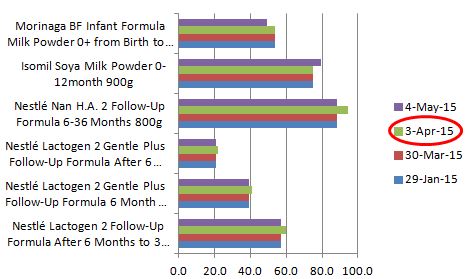
For infant milk powder, which should be exempted from the 6% GST, surprisingly, we saw some Nestle products on Tesco Online became more expensive after 1 April 2015 with a hike of between 4.97% and 6.91%. On the other hand, several Nestle infant formula saw 0.5% price reduction. Most of the other brands kept their prices unchanged, which should be the case since infant formula is not subject to the GST.
Infant milk powder (price check 27 March 2015 vs 2 April 2015) %
Nestlé Nan H.A. 2 Follow-Up Formula 6-36 Months 800g 6.91
Nestlé Lactogen 1 Infant Formula Milk Powder from 0 Month to 12 Months 350g 6.80
Nestlé Lactogen 2 Follow-Up Formula After 6 Months to 3 Years 1.8kg 4.90
Nestlé Lactogen 1 Infant Formula Milk Powder from 0 Month to 12 Months 1.8kg 4.98
Nestlé Lactogen 2 Gentle Plus Follow-Up Formula 6 Month to 3 Years 2 x 650g 4.97
Nestlé Lactogen 2 Gentle Plus Follow-Up Formula After 6 Month to 3 Years 650g 4.55
Nestlé Nan Pro 2 Follow-Up Formula After 6 Months to 3 Years 2 x 350g -0.43
Nestlé Lactogen 2 L Comfortis + DHA Gentle Plus Follow-Up Formula 350g -0.42
Nestlé Nan H.A. Grow 3 Formulated Milk Powder for Children for 1 Year to 3 Years… -0.39
Nestlé Nan Pro 1 Infant Formula From 0 Month to 12 Months 2 x 350g -0.21
S-26 SMA Step 1 Infant Formula 1.2kg -0.20
S-26 SMA Step 1 Infant Formula 600g -0.19
Dumex Mamex Cherish 1.5kg -0.19
Frisolac Step 2 2 x 350g
Frisolac Step 2 900g
Nestlé Lactogen 1 GOS FOS + DHA Gentle Plus Infant Formula 650g
Similac Total Comfort 1 820g
Anmum Infacare 1 Milk Powder 900
Dumex Bebelac Infant Formula 0 – 12 Months 400g
Dumex Dulac Extra Care 400g
Dumex Dulac Lactose Free 400g
Dumex Mamex Cherish 1 600g
Dumex Mamex Gold Lactose Free 400g
Enfalac A+ Gentlease 900g
Enfalac A+ Step 1 Milk Powder 2 x 650g
Enfalac A+ Step 1 Milk Powder 650g
Isomil Soya Milk Powder 0-12month 900g
Morinaga BF Infant Formula Milk Powder 0+ from Birth to 1 Year 900g
Novalac DHA & ARA Infant Milk Powder 800g
Similac 1 Advance Formula Milk Powder 900g
Enfalac A+ Lacto Free Milk Powder 900g
Source: Tesco Online Grocer
minimeinsights.blogspot.com/

When it comes to growing up milk, milk powder for 0-36 months should get a reprieve but some brands did saw an increase of between 0.88% and 5.7%. These include Dugro, Sustagen, Anmum and Nestle.

Growing up milk powder (price check 27 March 2015 vs 2 April 2015) %
Nestlé Nan Kid 4 Formulated Milk Powder for Children 3 Years to 6 Years 2 x 350g 5.70
Sustagen Junior 1+ Chocolate 650g 4.91
Sustagen Junior 1+ Honey 650g 4.91
Sustagen Junior 1+ Vanilla 650g 4.91
DUGRO 4 MULTI GRAINS 900G 4.35
DUGRO 4 HONEY 900G 4.03
DUGRO 5 HONEY 900G 4.03
DUGRO 5 REGULAR 900G 4.03
Anmum Essential 1+ Honey 3 Growing Up Milk Powder 500g 0.88
Anmum Essential 3 Formulated Milk Powder for Children 500g 0.88
Anmum Essential 1+ Honey Growing Up Milk Powder 1.6g -2.13
DUGRO 3 FRUIT + VEG 900G
DUGRO 3 HONEY 900G
Pediasure Complete Vanilla Flavoured Formulation Milk 1.6kg
S-26 PE Gold Picky Eater 1.4kg
S-26 Picky Eater Gold 900g
Similac Total Comfort Plus 820g
Enfagrow A+ Step 3 Vanilla Formulated Milk Powder for Children 1-3 Years & Above 1.7kg
Enfagrow A+ Step 4 Original Formulated Milk Powder for Children 4 Years & Above 1.7kg
Enfagrow A+ Step 4 Original Formulated Milk Powder for Children 4 Years & Above 600g
Sustagen Kid 3+ Chocolate 650g
Sustagen Kid 3+ Honey 650g
Sustagen Kid 3+ Original 650g
Sustagen Kid 3+ Vanilla 650g
Sustagen School 6+ Chocolate 650g
Sustagen School 6+ Honey 650
Sustagen School 6+ Vanilla 650g
Source: Tesco Online Grocer
minimeinsights.blogspot.com/

The prices obtained from Tesco are Guide Price.

Conclusion: Based on the guide price, we find there are cases of price hike on milk products that should be exempted from the 6% GST. For non-GST exempted milk powder, some of the brands choice to absorb the GST by maintaining their pre-GST prices. Therefore, we cannot assume all milk product prices will rise by 6% post GST or stay the same for exempted products.

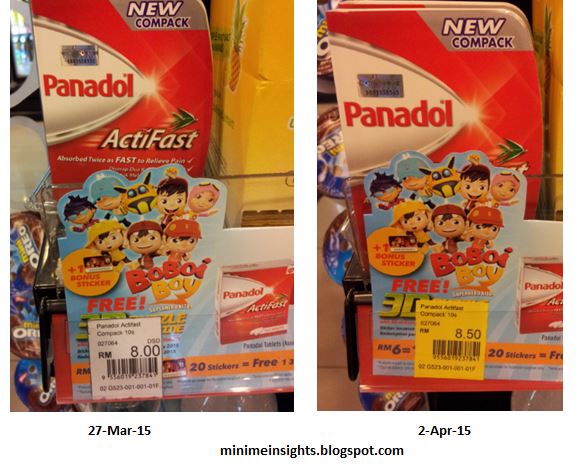
GST Watch: Should 7-11 charge 6% GST on Panadol?

The question is should 7-11 charge 6% GST on Panadol ActiFast? According to the Customs Department, all forms of Panadol should be exempted from GST.

Potential for drinkable oat in Malaysia

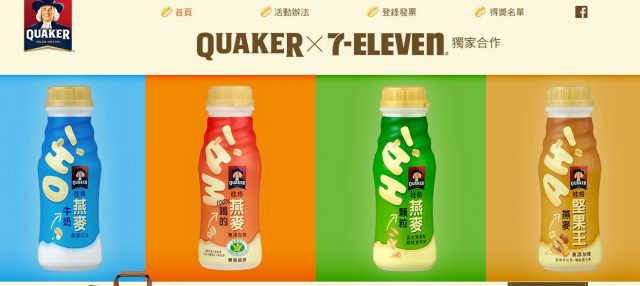
While in Taiwan, I noticed there is a drinkable cereal by Quaker. The product packaging has just been giving a facelift. The 280ml drink comes in four varieties and the taste is great.

In Indonesia, PT Milko Beverage Industry also has a similar Milko cereal drink. However, I find the drink tastes quite artificial.

Malaysians drink a lot of 3-in-1 cereals such as Nesvita and Nestum. We also consume instant oat meals. The recent beta glucan craze epitomised by Biogrow Oat BG 22 also led to the introducing of a range of new products with added beta glucan that acts as a cholesterol-controlling agent. 

My initial thought is there is surely a market for drinkable oat in Malaysia as a meal replacement. Cost wise, the Quaker drinkable oat is priced at TWD25 (RM2.9) in convenience stores in Taiwan. The price range of RM 2-3 is acceptable as a soya bean drink in a 7-11 in Malaysia is about RM 1.5 to 2. If you eat with a sweet bun, it is an additional RM 0.9 to 1. Hopefully, we will be getting something similar to Quaker in Malaysia soon.

HOT NEWS

G&G operates 290 convenience stores in Myanmar

0
CDSG, which operates a chain of convenience stores under the "Grab & Go" or “G&G” brand in Myanmar, disclosed at Tastefully Myanmar that it currently has...

MUST READ

Pepsi Max Taste Rapsberry set to fuel the sugar-free CSD market...

0
Raspberry is the new flavour of Pepsi Max in Thailand. The new raspberry flavour capitalises on the 54% year-on-year growth of the THB 1.8...